
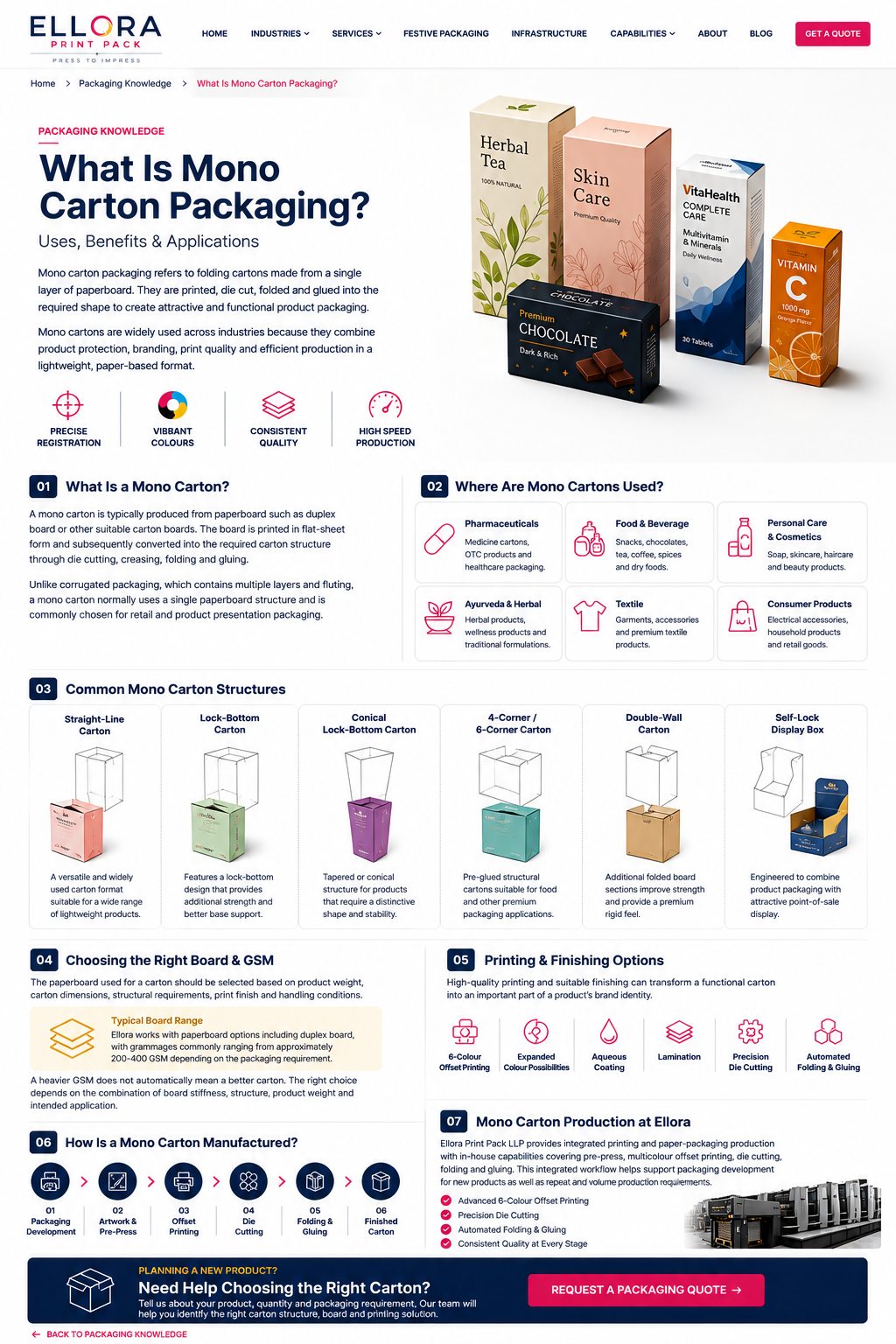
A visual guide to mono carton applications, structures, materials, printing and manufacturing.
Ellora Print Pack LLP manufactures custom printed mono cartons at its Salem manufacturing facility in Tamil Nadu. We support brands with carton development, multicolour offset printing, aqueous coating, precision die cutting, folding and gluing.
Mono carton packaging is widely used for pharmaceuticals, food and beverages, cosmetics, personal care, healthcare, textiles and other consumer products. Produced primarily from paperboard, these cartons combine product protection, branding and high-quality printed presentation.
What Is a Mono Carton?
A mono carton is generally produced from paperboard such as duplex board or other suitable carton boards. The board is printed in flat-sheet form and subsequently converted into the required carton structure through die cutting, creasing, folding and gluing.
Unlike corrugated packaging, which contains multiple layers and fluting, a mono carton normally uses a single paperboard structure and is commonly chosen for retail and product presentation packaging.
Where Are Mono Cartons Used?
Mono cartons can be customised for a wide variety of products and industries.
Why Do Brands Use Mono Cartons?
Excellent Print Quality
Paperboard provides a suitable surface for high-quality offset printing, detailed graphics, product information and strong colour reproduction.
Strong Brand Presentation
Carton structure, colour, graphics and surface finishing can work together to create distinctive retail packaging.
Customisable Structures
Cartons can be engineered as straight-line, lock-bottom, conical, double-wall and other specialised formats depending on the product requirement.
Efficient Production
Modern printing, die-cutting and folder-gluer equipment enables consistent carton production from smaller requirements through larger production volumes.
Paper-Based Packaging
Mono cartons provide brands with a practical paper-based outer-packaging option where the product and protection requirements permit.
Common Mono Carton Structures
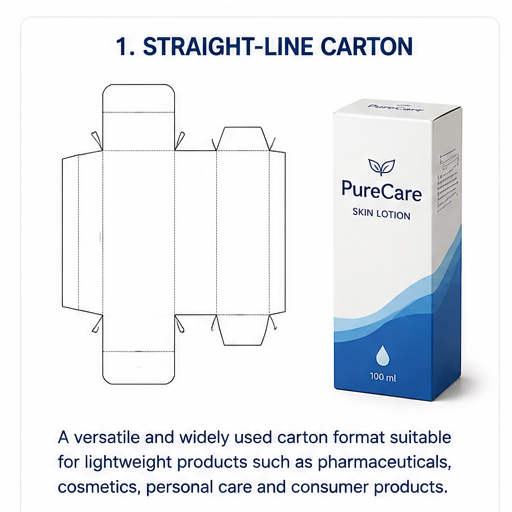
Straight-Line Carton
A versatile and widely used carton format suitable for lightweight products such as pharmaceuticals, cosmetics, personal care and consumer products.
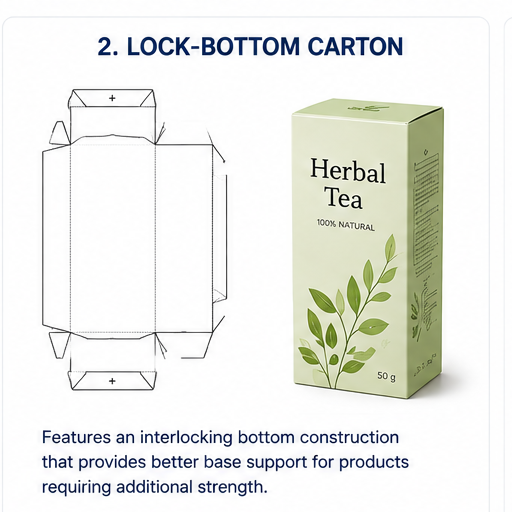
Lock-Bottom Carton
Features an interlocking bottom construction that provides better base support for products requiring additional strength.
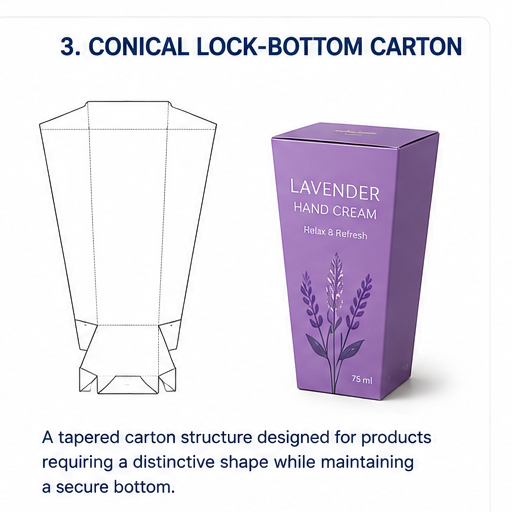
Conical Lock-Bottom Carton
A tapered carton structure designed for products requiring a distinctive shape while maintaining a secure bottom.
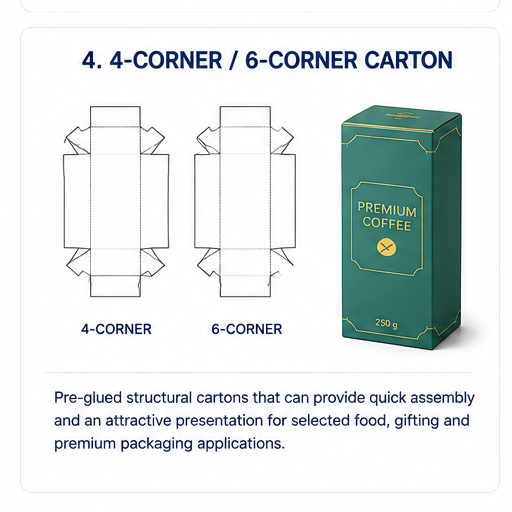
4-Corner & 6-Corner Cartons
Pre-glued structural cartons that can provide quick assembly and an attractive presentation for selected food, gifting and premium packaging applications.
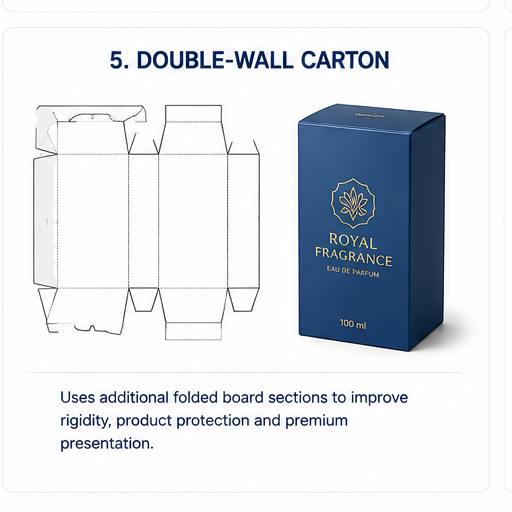
Double-Wall Carton
Uses additional folded board sections to improve rigidity, product protection and premium presentation.
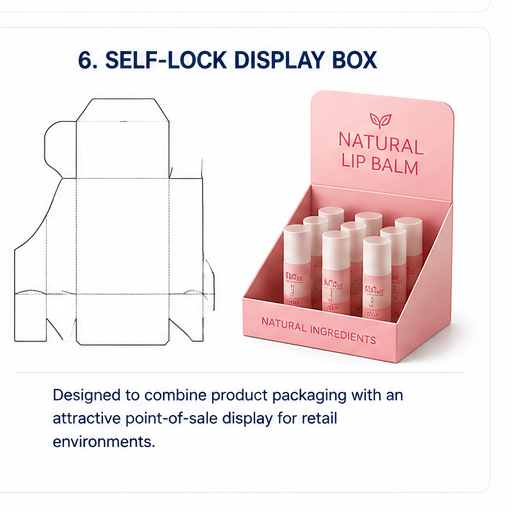
Self-Lock Display Box
Designed to combine product packaging with an attractive point-of-sale display for retail environments.
Choosing the Right Board & GSM
The paperboard used for a carton should be selected according to product weight, carton dimensions, structural requirements, print finish and handling conditions.
A heavier GSM does not automatically mean a better carton. The correct choice depends on the combination of board stiffness, structure, product weight and intended application.
Printing & Finishing Options
High-quality printing can transform a functional carton into an important part of a product's brand identity.
Aqueous coating can be applied to suitable printed jobs to provide additional surface protection and an enhanced finished appearance. Learn more about our aqueous coating for printed packaging.
How Is a Mono Carton Manufactured?
Mono Carton Manufacturer in Salem, Tamil Nadu
Ellora Print Pack LLP manufactures custom printed mono cartons at its Salem manufacturing facility in Tamil Nadu. Our integrated production capabilities include pre-press, 6-colour offset printing, aqueous coating, precision die cutting, automated folding and gluing.
We support packaging requirements for new product launches and growing brands, as well as repeat production, with carton structures, board specifications, printing and finishing selected according to the product and packaging requirement.
Need Help Choosing the Right Carton?
Tell us about your product, quantity and packaging requirement. Our team can help identify a suitable carton structure, board and printing solution.
REQUEST A PACKAGING QUOTE →