
ELLORA PRINT PACK LLP
PRESS TO IMPRESS
A practical guide to taking your packaging from an initial idea through structure, artwork, printing and finished production.
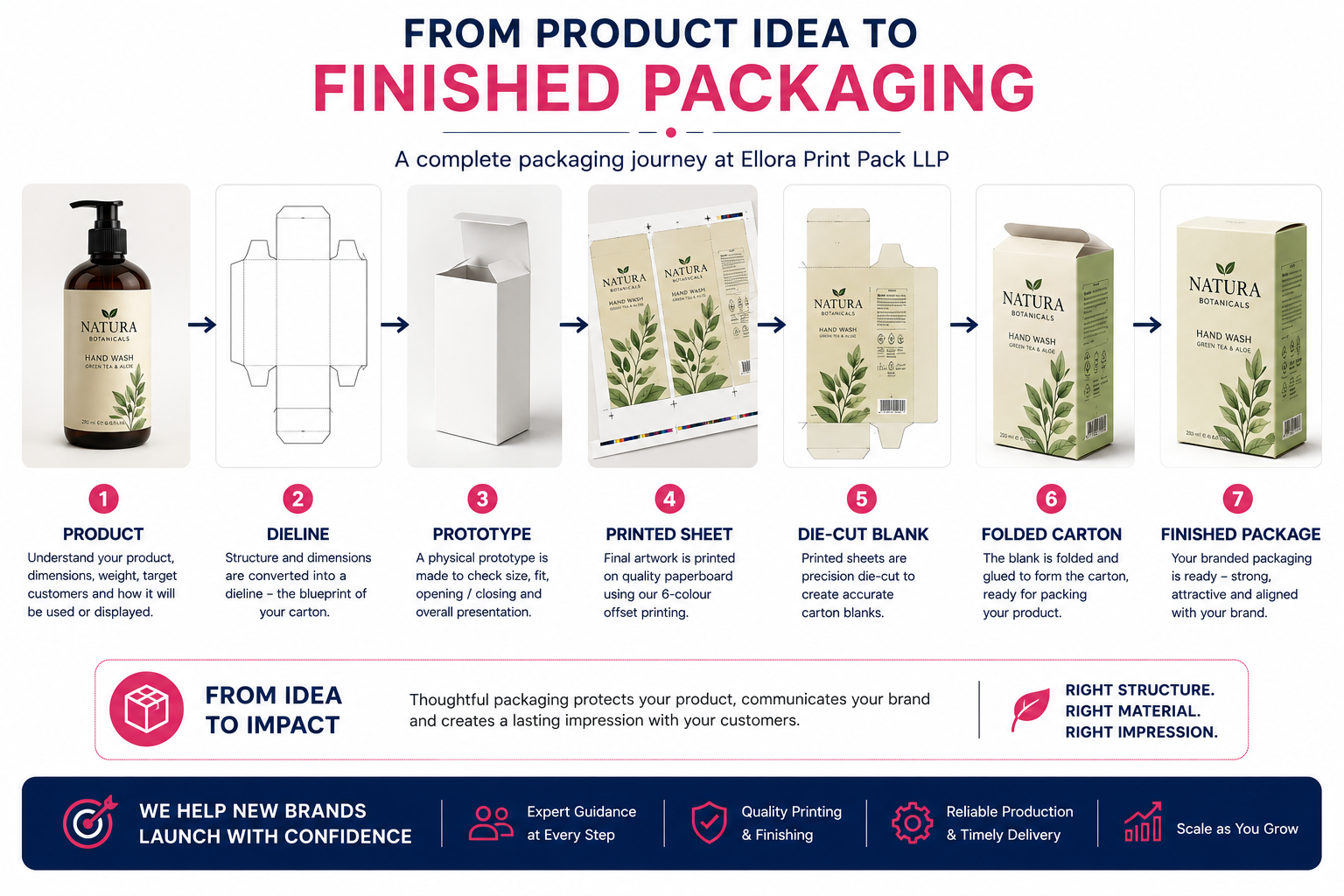
From product idea to finished packaging — a complete packaging development journey for new and growing brands.
Good packaging development starts with understanding the product. Before deciding the carton size, board or printing method, consider the product dimensions, weight, shape, handling requirements and how the product will be displayed or distributed.
These factors help determine the right packaging structure and avoid selecting a carton simply because it looks attractive.
Accurate length, width and height help determine the internal dimensions and overall carton size.
Product weight influences board selection, carton construction and the amount of base support required.
Consider the level of protection required during packing, handling, transportation and retail display.
Packaging should also communicate your brand clearly and present the product effectively to the customer.
Different products require different packaging structures. The appropriate carton should balance product protection, ease of packing, presentation and production efficiency.
Once the packaging structure has been selected, the next step is choosing a suitable paperboard and grammage. The correct board depends on the size and weight of the product, carton dimensions, structural requirements and desired print finish.
Choosing the highest GSM does not automatically produce the best packaging. Board stiffness, carton structure and product weight should be considered together.
After the basic structure and dimensions are established, the packaging is converted into a dieline. The dieline acts as the technical blueprint of the carton.
It identifies the panels, folds, creases, cutting lines and glue areas required to convert a flat printed sheet into the finished package.
Defines how the carton will open, close, fold and support the product.
Converts the product dimensions into an accurate packaging layout.
Helps ensure logos, text, graphics and mandatory information are correctly positioned on each carton panel.
Provides the technical reference required for printing, die cutting, folding and gluing.
For a new product, checking the carton structure before full production can be an important part of packaging development.
A physical prototype allows the brand to evaluate the carton dimensions, product fit, opening and closing arrangement, structural behaviour and overall presentation.
Once the packaging structure and artwork are approved, production moves into printing and finishing. Printing quality is important because the carton often becomes one of the first physical interactions a customer has with the brand.
New brands often face an important question: how much packaging should be produced for the first order?
The answer depends on expected product demand, launch strategy, packaging specifications, production economics and how quickly the brand expects to reorder.
Instead of focusing only on the lowest possible quantity, consider the overall cost per carton, expected product movement and the quantity that makes commercial sense for your launch.
Your first packaging requirement may be relatively small. As your product grows, your packaging production needs to grow with it.
Developing the right structure, dimensions, artwork and production process from the beginning can make future repeat orders easier and help maintain packaging consistency as volumes increase.
Ellora Print Pack LLP supports new brands and product launches with packaging development and production from its manufacturing facility in Salem, Tamil Nadu. Our integrated capabilities include pre-press, multicolour offset printing, aqueous coating, precision die cutting, folding and gluing.
Whether you are preparing your first product launch or planning repeat and volume production, the objective is to develop packaging that is practical to manufacture, suitable for the product and consistent with your brand.
Tell us about your product, dimensions, expected quantity and packaging idea. Our team can help you identify a suitable structure, material and printing solution.
START YOUR PACKAGING PROJECT →